Last year, I started doing some on-call technical advising for ATscale (if you don’t know them, you should check out their work). That role meant spending a lot of time digging into the realities of Assistive Tech in low- and middle-income countries. Alongside that, I’ve been working on the VoiceGarden project. We need data for TTS. Building a new voice in 2026 is fairly straightforward if you have the foundational data, like phonemisation and time-stamped transcribed audio. Combine that with some recent work I’ve been doing with Loughborough looking at bio-sensing, and I started thinking about the wider structural problem.
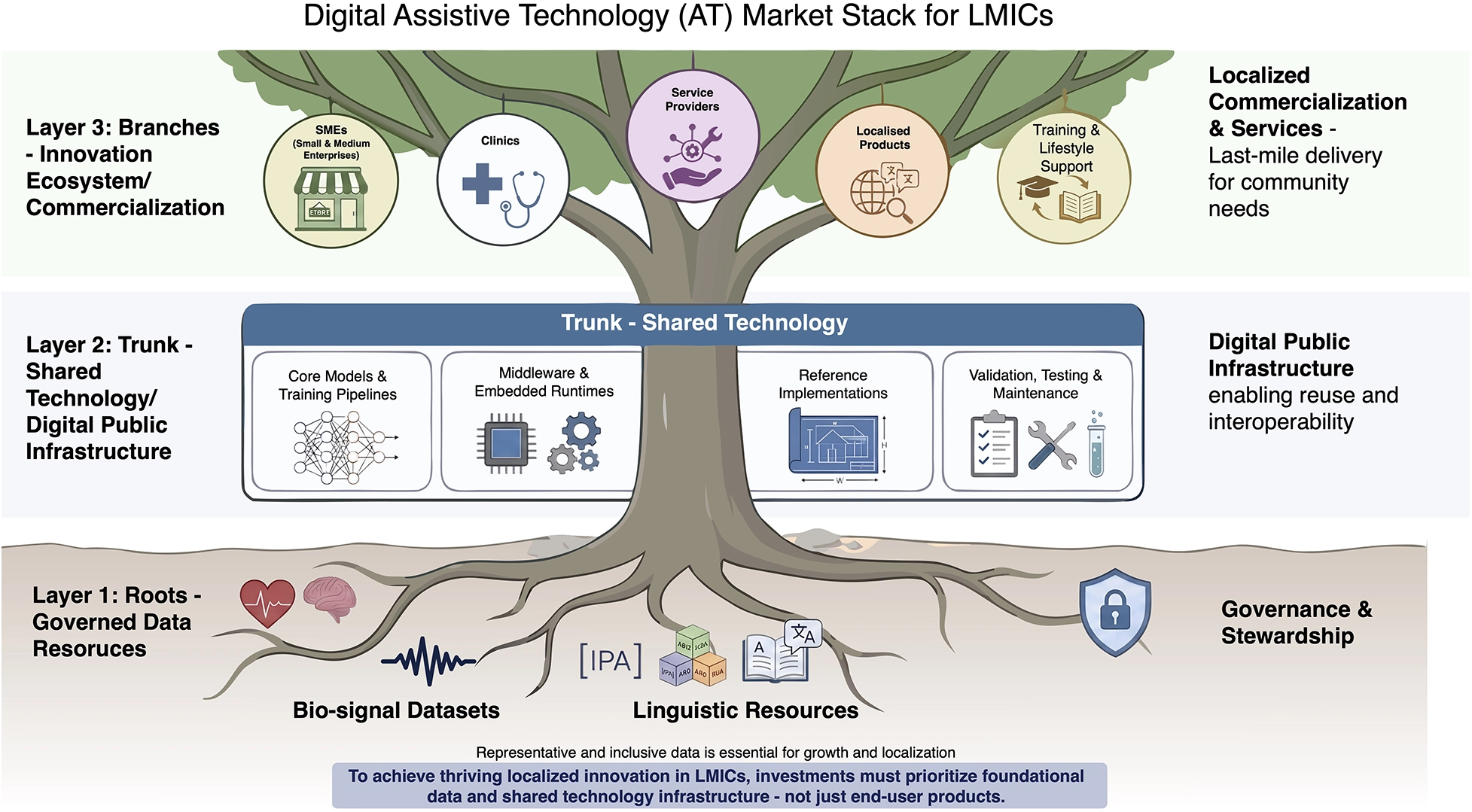
When I got invited to write for a special edition on markets in AT, I ended up putting those pieces together. (And yes, I made a picture to explain it).
Here is the gist: smartphones are useful, but they are not a universal solution for global AT. If the power is unreliable, data costs a fortune, or the text-to-speech doesn’t speak your language, an app does not help much. A low-power, offline, dedicated device is often a better tool for the job. (Nb. My take is further than this but I won’t get into the weeds here).
In the new paper, I argue that instead of only government / ngos supporting end products we need to fund the raw data, language models, and open-source toolchains that make the rest of the “stack” work efficiently. If we build that shared digital public infrastructure, local developers and clinics can build the devices that make sense for their communities.
I call it the Market Stack - although I think maybe i should of got Claude/chatGPT to come up with a better tree-type name! Give the full paper a read here: www.frontiersin.org/journals/…