Will Wade
About code Archive Photos Bookmarks
  • Your brain can sometimes do funny things to letters. OpenDyslexic tries to help prevent some of these things from happening. Letters have heavy weighted bottoms to add a kind of “gravity” to each letter, helping to keep your brain from rotating them around in ways that can make them look like other letters. Consistently weighted bottoms can also help reinforce the line of text. The unique shapes of each letter can help prevent flipping and swapping.

    OpenDyslexic is free like a free beer, and freedom. Go get it here: dyslexicfonts.com

    → 11:08 AM, Oct 7
  • ' .The Apple Event Abstract . ;

                                                           ' .Crowds Arriving..  . ;
                                                                                                                      Last night I did a little presentation on AAC at the Apple Store, Covent Garden. We had a range of folk, from parents to Doctors and therapists and some folk looking for solutions for themselves. Thanks to everyone at Apple store Covent Garden for dealing with my slide issues and poor microphone handling skills!
    

    If you came along here’s some of the links: The list of Apps (about to be updated later this weekend!): AppsForAAC, CPC Farnell - a supplier of a range of kit including the Forward, Life Jacket - a fab waterproof and rugged case which only 2 evenings before I happily delivered to a child on my teams caseload. I’ll try and add the slides when I can get them back from Apple :)

    Thanks to the GOSH team & Sandra from Logan who came out to give me some support and shared a nice bit of Japanese tuck and beer with after. I fully recommend Hu Sushi, Charlotte Street and the eel rice stuff!

    update: Obviously a large chunk of this talk was about AAC & Assistive software on Apple devices. A large chunk was also Communication Matters heavy in directing folk to their local AAC centre.

    → 2:40 PM, Oct 6
  • Tim Kelsey, the NHS Commissioning Board’s first national director of patients and information, is to encourage doctors and nurses and other front-line staff to learn how to program. — Sweet. And OTs! and OTs!

    → 8:09 PM, Oct 5
  • Film 4. It’s a bit like TK Max. Mostly crap bit you occasionally find something half decent — Turning on the telly to find “The day after tomorrow” - certainly not half decent

    → 7:32 PM, Oct 5
  • Eeeeeek!

    (Thanks To @SteveALee for spotting this… I think Thanks!)

    → 10:56 PM, Oct 1
  • Wheelchair users in South Africa really must have their brakes checked. (via)[http://www.reddit.com/r/WTF/comments/w9rj1/wheelchair_warning_sign_in_south_africa/]

    → 9:15 PM, Jul 9
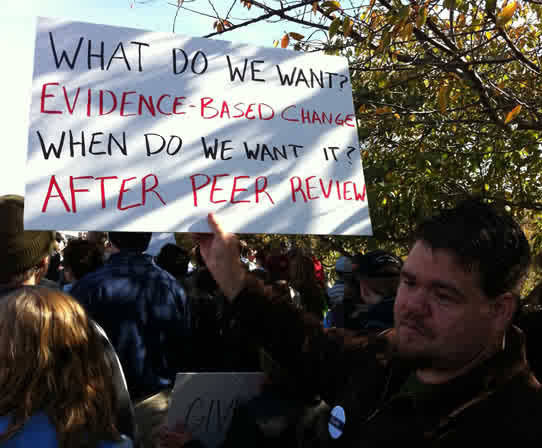
  • “What do we want?! Evidence-based change! When do we want it?! After peer review!” (from here)

    → 8:02 PM, Jun 23
  • Hmmm. Interesting positioning equipment to use whilst lying down that.

    → 7:43 AM, Jun 6
  • Eventually a common theme became apparent: Apple’s applications — Calendar, Messages, Mail, iPhoto, even Maps and most surprisingly Camera — are completely usable by blind people. These applications aren’t using any kind of secret API sauce. They’re using the same UIAccessibility framework you and I have access to.

    To get your mind blown, fire up Camera and point the camera at a nearby face, preferably a cute infant.

    Well I never knew that about the camera app. Thats pretty neat.

    → 4:55 PM, Jun 5
  • This past fall, Obert took a class on assistive technologies. Coincidentally, in the first week the students took turns riding in wheelchairs around campus to better understand the challenges a paraplegic faces. Obert thought the exercise was superficial. “I understand the idea,” she says, “but at the same time it felt a little bit trivializing. People were like, ‘Oh, it’s so hard to open the door’ … and [that’s] such a small, tiny piece of what you actually have to deal with every day if you’re in a wheelchair.” Better, she says, to talk to people with a disability, to shadow them for a day and ask them about what they need. — Wheels on the Ground - Technology Review

    → 3:59 PM, Jun 1
  • It’s roughly equivalent to giving someone a car in which the steering wheel has been replaced by a joystick. Not only do you need to learn how to steer with a joystick, but all of the controls formerly attached to the steering column are now scattered in various spots on the dashboard. The wiper control is a lever above the radio, the high beam lights are a switch on the rearview mirror, the turn signal is a set of buttons under the speedometer, and the cruise control is a dial hidden inside the ashtray. Oh, and you honk the horn by bouncing up and down in your seat. —

    Michael Mace, on the issue of how Windows 8 is not the easiest to use if you have spent the last x years on traditional “Start” menu based Windows.

    Does this not sound rather like an analogy for users of Assistive Technology? Where even small changes; say a moved switch, a sticky rollerball, a joystick no longer in the same place or the debounce on the keyboard being changed - causes equal amounts of “annoyance”.

    In short, if you change something think hard and long about it and keep it that way for as long as possible. Otherwise you may end up making your users feel like they are driving clown cars when they want to be doing far more important things like communicating.

    → 7:53 AM, Jun 1
  • The Canadians know how to advertise their own Paralympic team.

    → 7:44 AM, May 31
  • In computer terms, I have a baud rate of about three that responds to the information in about 20 words a minute. By contrast, a political speech has a word rate of about 150 and an information content of zero. — Stephen Hawking. From an interview with Larry King in 1999.

    → 8:08 PM, May 29
  • Wheelchair rams (Happy Birthday Sue!)

    → 6:35 PM, May 27
← Newer Posts Page 7 of 7
  • RSS
  • JSON Feed